

Why you should not buy a used motorcycle helmet
1 Nov 2026 · 8 min read
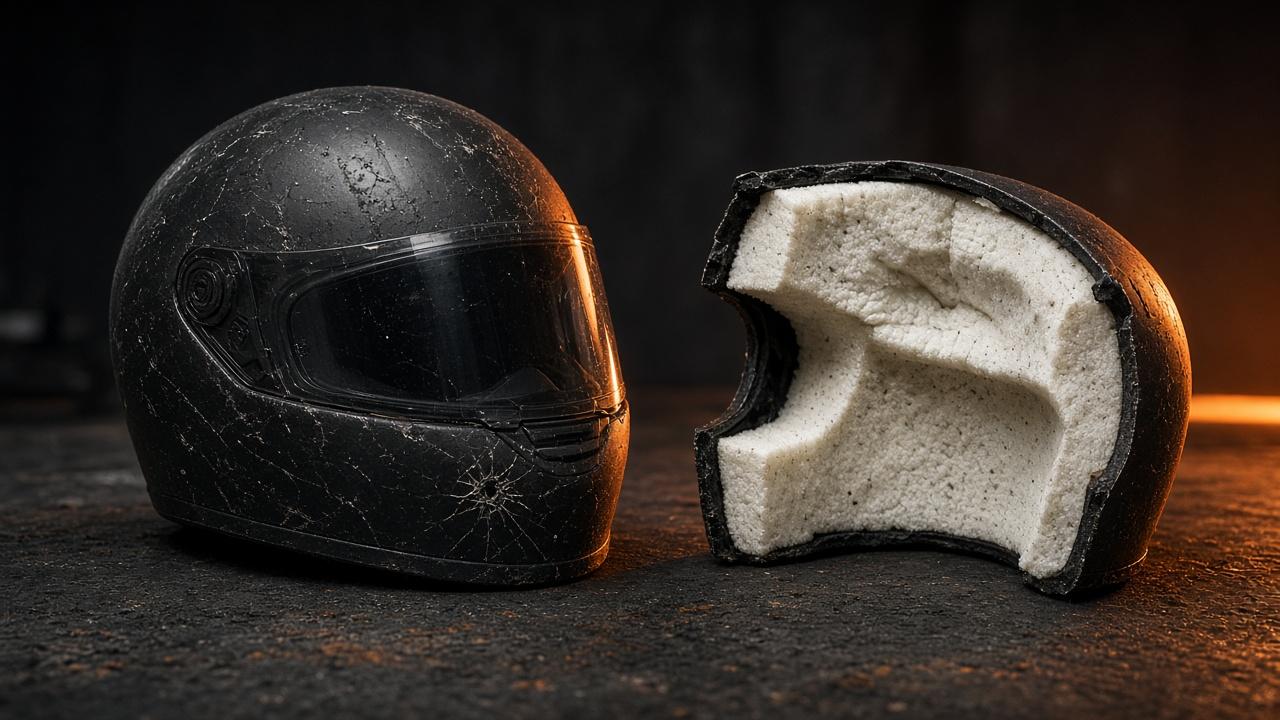
A used helmet looks like a bargain: a known brand, paint that looks whole, a price below a new one. But helmet makers agree on one thing: the part that matters cannot be checked from the outside. Here is what Shoei, Arai, HJC and Schuberth say, what the law in Estonia requires, and what to check if you still decide to take a used one.
A helmet is made for one impact
Under the hard outer shell a helmet has a layer of expanded polystyrene, EPS. That is what takes the impact: the foam crushes and absorbs the energy.
- Shoei: a helmet is made to absorb one impact. After a crash or a fall it has to be replaced, even if there are few marks outside, or none.
- HJC: a helmet is rated for one impact only. An impact can crack the shell or compress the EPS layer, and you may not see it. Any impact in a crash can damage a helmet, or a fall from only about 1.2 metres (4 feet).
- Arai: in a hard impact the energy is absorbed by the shell and the EPS layer breaking in part, and that damage may not be visible.
The seller may honestly say it never fell. You cannot check that, and the helmet will not tell you.
A helmet cannot be checked, even at the factory
- Shoei: fine cracks in the shell and deformation of the EPS layer cannot be seen without destroying the helmet. That is why Shoei does not inspect helmets after a crash or a fall and does not certify that a helmet is sound.
- Schuberth: the protective properties of a helmet cannot be checked without destroying it, so Schuberth does not do that check.
- Arai: the EPS layer in their helmets cannot be removed, and there is no certain way to know whether it is damaged inside. Arai’s advice: if you are in doubt, buy a new helmet.
Shoei adds: if an empty helmet falls from a small height, usually only the paint or the outside parts suffer, because without a head inside the foam barely crushes. But if the shell itself is damaged, the helmet has to be replaced at once. HJC calls a height of about 1.2 metres dangerous. A buyer does not know exactly how a used helmet fell.
A helmet has a service life
Even a helmet that has never taken a hit gets old.
- Shoei advises replacing a helmet after about 5 years of ordinary use: over the years the EPS foam absorbs impact less well, and the helmet may no longer protect at the level of its ECE approval.
- Arai advises replacing a helmet 5 years after purchase and 7 years after it was made. Arai says the EPS foam loses air from its cells over time, even when the helmet is not used.
- Schuberth advises replacing a helmet every 5 to 7 years, depending on use and care.
- HJC: replace it every 3 to 5 years, depending on how often you ride. Ultraviolet light and the ageing of glue and parts spoil a helmet over time.
Arai also writes that by about five years the inner liner wears out, and the helmet can start to sit more loosely. Sweat, hair products, cleaners and ultraviolet light all play a part.
The visor ages too. Shoei advises replacing a visor no later than 5 years: polycarbonate grows brittle in the sun and can crack in a fall. Shoei advises replacing a scratched visor at once.
So with a used helmet it matters when it was made, and when someone started riding in it.
What the previous owner may have done to it
A helmet can be ruined without a fall. According to the makers’ instructions:
- petrol, solvent, benzene and other solvents can damage the EPS layer and the plastic parts, and the damage may not be visible (Arai);
- a helmet must not be dried on strong heat or left in the sun in a closed place, for example on the rear shelf of a car (Arai);
- do not drill the shell, or press or cut the foam (Arai);
- stickers and tape on the visor weaken its protective coating (Arai);
- in a repaint the paint can damage the foam and the plastic if everything inside is not covered (Arai).
FEMA, the Federation of European Motorcyclists’ Associations, reminds riders that a helmet must not be changed from the way it left the factory. Only accessories that were tested with the helmet keep the approval.
From a used helmet you cannot tell whether it was washed with petrol, whether it sat under a car window in summer, or what was fixed to it.
What the law requires in Estonia
- On a motorcycle and a moped the rider and the passenger must wear a fastened motorcycle helmet (Traffic Act, § 30 and § 33).
- The rider must not carry a passenger without a fastened motorcycle helmet (Traffic Act, § 33).
- A motorcycle helmet and its visor must meet UN Regulation No. 22 (ECE 22). The visor must transmit at least 80% of light in the dark and at least 50% by day (vehicle requirements, Annex 1, code 111).
How to read the ECE label
Under Regulation No. 22 every helmet must have a label sewn to the chin strap. According to FEMA, it shows:
- the letter E in a circle with a number, the country where the model was tested and approved (for example E1 is Germany, E3 is Italy);
- a number that starts with 06 means the helmet is approved to ECE 22.06, and 05 means the older 22.05;
- the letters between the numbers are the helmet type: J is open-face, P is a full-face with a protective chin bar, NP means the chin bar does not protect, P/J is a modular helmet you can ride with the chin bar up or down;
- the number after the hyphen is the serial number.
ECE 22.06 added an angled impact test that measures how fast the head rotates, and a visor test with a steel ball at 60 m/s: the visor must not crack, deform or come out. Another new requirement of 22.06 is that the helmet must show the year it was made.
If you bought from a private seller
The Consumer Protection and Technical Regulatory Authority (TTJA) warns: if you buy from a private person, including through online marketplaces and social networks, consumer-protection rules do not apply to you. There is no legal right to a claim and no right to cancel the purchase within 14 days. You cannot take the problem to the TTJA. A dispute with a private seller is settled only in court.
If you buy from a company in an online shop, the TTJA says you can cancel the purchase within 14 days, and the seller is responsible for two years for the goods matching the contract.
If you still take a used helmet
What to check, from the makers and FEMA:
- the ECE label on the strap: the number should start with 06 (ECE 22.06), and the type (J, P, P/J) should match how you will ride;
- the year of manufacture: Arai advises not using a helmet longer than 7 years after it was made, and Shoei, Schuberth and HJC give a span of 3 to 7 years;
- whether the helmet has been in a crash or has fallen: after any impact on the head, Shoei, HJC and Arai advise replacing the helmet;
- whether the shell, the foam inside and the strap buckle are sound: HJC says all three should be in good condition;
- whether there are signs of a repaint, holes, homemade mounts or stickers on the visor (Arai, FEMA);
- the visor: no scratches in the field of view, and not older than 5 years (Shoei);
- the fit: the helmet should not sit loose, and the liner should not be worn out (Arai).
But even if all of that is in order, damage to the foam inside cannot be seen. Shoei, Arai and Schuberth say so directly.
Id no. 88