

Ten rules that keep a motorcyclist safe on the road
1 Nov 2026 · 8 min read
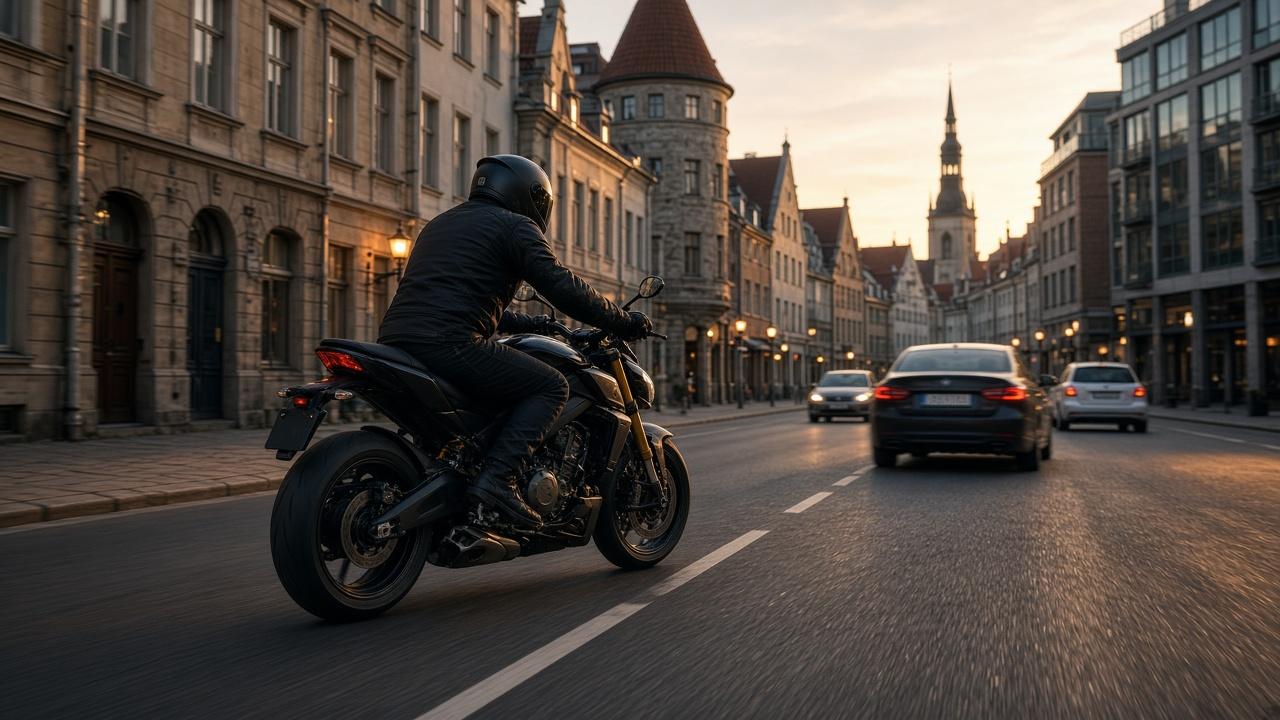
A motorcyclist has no bodywork, no seatbelt and no airbags. Between the rider and the asphalt there is only the kit, and between the rider and a crash there is the rider’s own attention. We gathered ten rules worth keeping in mind on every ride, and checked them against Estonia’s Traffic Act and the latest Transport Administration report.
1. Check the motorcycle before you leave
The law requires a driver to make sure the vehicle is sound before a trip, and to keep an eye on it on the way. For a motorcycle this matters even more: a fault a car will survive, a bike often will not forgive.
Before you ride, look at:
- the tyres: pressure, cuts, tread left;
- the brakes: the lever and the pedal work cleanly, no fluid leaks;
- the chain: tension and oil;
- the lights: headlamp, brake light, indicators.
If something is wrong, put the ride off. A repair in the garage is cheaper than a repair after a fall.
2. Kit is required, but it does not save you from everything
In Estonia the rider and the passenger must ride in a fastened helmet. The Transport Administration advises not to save money on gear, and warns that in a slide at only 50 km/h clothes tear to shreds, and skin and muscle are worn down to the bone.
The authority’s advice:
- take a helmet with chin protection: an open helmet protects the skull, but not the jaw;
- the helmet should sit firmly on the head and the cheeks, but not press;
- choose a bright jacket and a bright helmet, and over dark clothes wear a reflective vest;
- zips are better covered by a flap: in a fall the metal heats up and burns the skin.
But kit only softens the impact. It does not cancel a crash. According to the Transport Administration, all three motorcyclists killed in Estonia in 2025 were wearing helmets.
3. Choose speed for the road, not for the engine
Outside built-up areas Estonia allows 90 km/h, and in town 50 km/h, unless signs allow more. But the law asks for more than keeping the limit. Speed has to match your experience, the state of the road and the motorcycle, the weather and the density of traffic, so that you can stop within what you can see.
A powerful motorcycle accelerates faster than almost any car in the stream. The higher the speed, the later you are noticed, and the less time you have for someone else’s mistake. If you want to find out what you and the bike can do, go to a track or a practice session on a closed lot.
The Transport Administration’s 2025 report has this case: in town a motorcyclist at high speed failed a right-angle bend and left the road into the metal structure of a footbridge.
4. At a junction, expect a mistake from a car turning left
A motorcycle is narrow, and a car driver easily misses it or misjudges its speed. The most typical crash: a car turns left and pulls out in front of an oncoming motorcycle. By law, the driver who turns left or makes a U-turn must give way to oncoming traffic. But the rules will not stop the car for you.
In 2025 a motorcyclist in Estonia was killed that way: an elderly driver at a junction turned left and pulled out in front of him.
What helps:
- before a junction roll off the throttle and keep your fingers on the brake;
- watch the wheels of a car waiting to turn: they show first that it has started to move;
- on a fresh green do not launch until you are sure the junction is clear;
- a yellow signal in law forbids going on, and you may pass only when it is no longer safe to stop.
5. When you overtake, think where the car ahead will turn
You are overtaking a line of traffic, and the car ahead decides at that moment to turn left towards a house or a side road. The driver looks in the mirror, sees an empty oncoming lane and does not notice the motorcycle already alongside. This is one of the most treacherous situations, because formally you are going straight, and the impact comes from the side.
How to lower the risk:
- do not start an overtake next to junctions, exits and filling stations;
- watch not only the indicators, but whether the car drifts towards the middle of the road and slows;
- if you are unsure, it is better to put the overtake off for a couple of hundred metres.
6. Keep to your half of the road
On a country road the law requires you to keep as close to the right edge as conditions allow. Even if there is no paint, an invisible centre line divides the road, and you must not cross it in bends. Cutting a bend puts you on the other half, and in a head-on crash the speeds add up: 90 plus 90 is 180 km/h.
The Transport Administration’s 2025 report describes a motorcyclist who at high speed went onto the oncoming lane and hit a tractor.
On Estonian country roads expect a tractor, an elk, or a car pulling out from a gravel road. By law a driver leaving a gravel or dirt road must give way to those on the paved road, but it is better to be ready in advance for the chance that they will not.
7. Rain and a poor surface
Wet asphalt grips worse than dry, and some places on it become almost like ice. It is especially slippery on:
- the paint of lane markings and pedestrian crossings;
- manhole covers and metal joints on bridges;
- bitumen patches over cracks;
- puddles you cannot see a hole under.
In spring, sand and gravel from the winter stay at the verges and at exits. In the rain increase your gap, brake more smoothly, and lean the motorcycle less than usual in a bend. The law separately requires you to slow down if visibility has got worse.
8. Barriers, posts and trees
For a car driver a crash barrier is often a rescue. For a motorcyclist it is a hard obstacle with sharp edges. Barrier posts, signs and trees by the road are more dangerous in a fall than the asphalt itself.
So:
- in a bend do not hug the edge where a barrier stands;
- enter the bend so there is a margin for a mistake;
- look where you want to go, not at the obstacle: the motorcycle goes where you look.
9. Leave stunts for a closed lot
The law requires you to ride a motorcycle so that all the wheels stay in contact with the road, and to hold the handlebar with both hands. That means riding on one wheel in the street is directly forbidden. It is not only the fine: one mistake in a stunt like that on a public road ends in a fall in a stream of cars. If you want to learn stunts, do it on a closed lot.
10. In dense traffic: a gap, and watch the doors
There is no special lane for motorcycles on an ordinary road. In traffic you are a road user like everyone else. The law requires a gap to the vehicle ahead of at least 2 seconds in a built-up area and 3 seconds outside it, and a safe space to the side.
If you ride next to cars that are stopped or moving slowly, remember:
- the driver or a passenger may suddenly open a door;
- a car may change lane sharply without looking in the mirror;
- in a jam people often look at a phone.
Keep the speed low and be ready to stop at any moment.
The figures for 2025
According to the Transport Administration, 43 people were killed on Estonia’s roads in 2025, a record low. Three of the dead were motorcyclists. But for motorcyclists the picture is worse than for the country as a whole: the number injured among them rose by 10 compared with 2024. Crashes with no other vehicle involved rose by 16 among motorcyclists, which is 29%. It is the only group in which the number of such crashes grew.
The main point
A motorcycle does not forgive haste or overconfidence. Check the machine, dress in something bright and tough, choose speed for the conditions, and always assume the other driver does not see you. Then the season ends in the garage, not in hospital.
Id no. 89